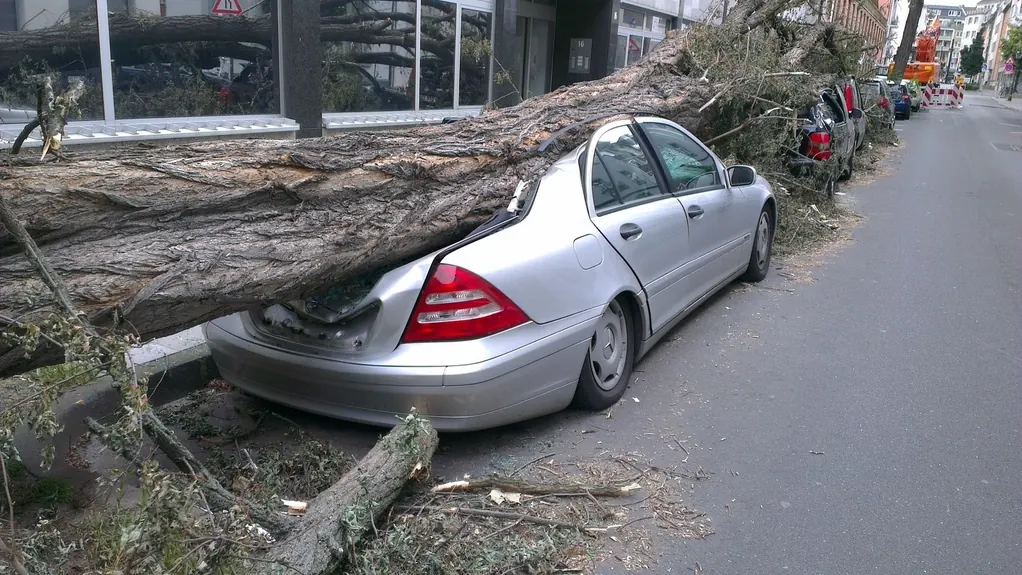
Two numbers, not one
A tree claim usually has two separate parts. The first is the damage the tree caused: a crushed roof, broken trusses, a split fence, a damaged carport. That’s normally paid under dwelling or other structures coverage, without a special cap. The second is removing the tree, which many policies treat differently.
Many policies limit tree debris removal to a set amount per tree and per occurrence, and some pay nothing to remove a tree that fell without hitting a covered structure or blocking a driveway. Illustrative example: a form that pays $500 per tree with a $1,000 per-occurrence cap would leave a homeowner with three large pines on the house well short of the crane bill. Check your own form; amounts and conditions vary.
Because the removal limit is fixed, the real dollar fight is usually over the structure repair — and over which costs belong in it.
What tree estimates often leave out
- Crane time and rigging needed to lift a tree off the house without causing more damage, which is part of protecting and repairing the structure.
- Broken rafters or trusses, sistering or replacement, and engineered repairs where needed.
- Roof decking, underlayment and shingles beyond the visible impact point.
- Interior ceilings, insulation and water damage from rain entering the hole.
- Emergency tarping and board-up.
- Fences, gutters, HVAC units and outbuildings hit on the way down.
Carriers sometimes treat the tree service’s invoice as one removal charge and apply the sublimit to the whole bill. A closer look often shows that part of the work — cutting the trunk off the roof in sections, crane lifts that keep the framing from collapsing, temporary shoring — was needed to protect and repair the house. We separate those costs so the sublimit applies only to debris removal, to the extent the policy wording supports it.
Storms that dropped trees across Mississippi
The Pine Belt around Hattiesburg, Laurel, Petal and Columbia is thick with tall loblolly pines, which snap or uproot in strong wind. The Easter Sunday outbreak of April 12, 2020, with its EF4 near Bassfield and Soso, left trees on homes across Jefferson Davis, Covington and Jasper counties. Hurricane Zeta on October 28, 2020, brought down trees along the Coast, and Hurricane Ida in August 2021 caused widespread wind and tree damage in southwest Mississippi around McComb, Brookhaven and Natchez.
In North Mississippi, large oaks and pecans around Oxford, Tupelo and Starkville cause the heaviest damage when they fail, and ice storms can bring them down as easily as wind. Our guide to ice storm tree claims in North Mississippi covers that pattern.
Take wide and close photos of the tree on the structure from several angles before anyone cuts it. Once the tree is removed, the extent of the impact is much harder to prove.
Whose tree, and why it fell
Under most homeowners policies, your coverage pays for damage to your home even if the tree came from a neighbor’s yard. Questions about a neighbor’s responsibility for a dead or neglected tree are legal matters, not appraisal issues. Likewise, if the carrier says the tree fell from rot rather than wind, that is a coverage question. Appraisal steps in once the carrier accepts the loss and the dispute is about the amount.
Tornado and hurricane overlap
Many tree claims come out of tornadoes and hurricanes, and the deductible that applies depends on the storm. See tornado and wind damage appraisal for related disputes, and our Hattiesburg and Forrest County page for the Pine Belt.
Available across Mississippi
Fallen Tree Claim Appraisal is available statewide. Inspections are scheduled around your timeline in places such as Southaven, Tupelo, Meridian, Oxford.
Fallen Tree Claim Appraisal questions
Will my policy pay to remove a tree that fell in the yard?
Often not, unless it hit a covered structure or blocked a driveway or ramp. Many policies only pay removal in those situations, and usually up to a set limit.
Can appraisal increase my tree removal limit?
No. The limit is set by the policy, but appraisal can value the full cost of repairing the structure the tree damaged.
My neighbor’s tree hit my house. Whose policy pays?
Usually your own homeowners policy pays for your damage. Whether your neighbor bears responsibility is a separate legal question for a Mississippi attorney.